The mesmerizing flow of a sidewinder moving across desert sands has captivated biologists for centuries, but questions remained about how the snakes produce their unique motion.
Emily Grubert, Assistant Professor in CEE, has contributed to a new report from Resources for the Future (RFF) entitled, "On the Path to an Equitable Energy Transition."
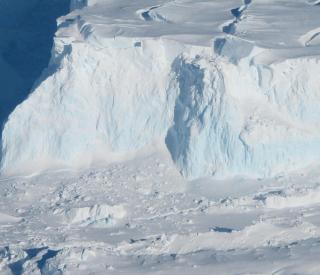
Antarctic supraglacial lakes have been linked to ice-shelf collapse and acceleration of inland ice flow. A new study shows lake area and volume vary substantially from year-to-year around the East Antarctic Ice Sheet and between ice shelves.
An international, collaborative team of researchers shed light on how fungi and plant roots work together to gather nutrients — and how the diversity of plant species may impact the process.
Electric vehicles are becoming increasingly popular, and with economic and environmental impacts colliding, Georgia Tech experts are leading the way in the development of next-generation solutions.
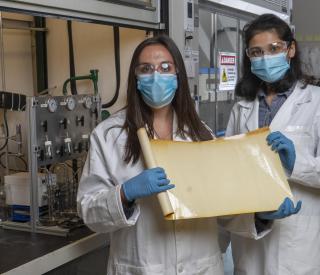
The Georgia Tech Research Institute (GTRI) is working to optimize Georgia’s EV battery supply chain by developing cost-and energy-efficient methods that pose fewer environmental risks.