
From the Ground Up: How University-Community Partnerships Are Advancing the Energy Transition
Building more energy transition technology facilities is often regarded as an unquestioned good. Community members where they tend to get built may not agree. Involving communities in the design process can result in better community acceptance and more appropriate implementation within the local context.
As communities across the Southeast grapple with the realities of a rapidly evolving energy landscape, Georgia Tech’s Center for Sustainable Communities Research and Education (SCoRE) is helping bridge a divide that has long existed between technological innovation and the people most affected by it.
Alexandra Rodríguez Dalmau, a community-engaged sustainability project manager with SCoRE, focuses on ensuring that communities have a meaningful role in shaping emerging energy transition technologies (EETTs) from the earliest stages of research through design and deployment. Her work sits at the intersection of research and practice, connecting technical expertise with community priorities related to energy, climate, and sustainability.
"Our main objective is to create a platform and process based on trust, where communities and technical experts can learn from one another," Rodríguez Dalmau said. "The goal is not to convince communities to support a particular technology, but rather to help everyone better understand the opportunities, tradeoffs, impacts, and questions that come with these technologies."
One of these projects is a regional community engagement program connected to the Southeast Direct Air Capture Hub (SEDAC), a U.S. Department of Energy-funded initiative led by the Southern States Energy Board. As conversations unfolded around direct air capture, a technology that removes carbon dioxide directly from the atmosphere, it became clear that many of the same questions and concerns can apply to the broader set of EETTs. Scaling low-carbon energy sources and systems that manage carbon after energy is produced — like hydrogen production, renewable energy systems, battery technologies, and energy infrastructure upgrades — may be considered an unqualified good thing. The SEDAC program brought to light that communities where such projects are built have a different perspective.
In the Fall of 2025, that SEDAC platform grew into the Southeast Community Energy Futures Academy (SCEFA), a training program and community of practice that brings together communities, technology researchers, and project developers to explore both the promises and challenges of EETTs.
"Communities are often asked to host facilities or infrastructure projects that serve broader resilience or climate goals," Rodríguez Dalmau said. "The benefits can feel distant while the risks and disruptions are immediate and local. Engaging communities early in the process is critical to ensuring that EETTs align with local priorities and support communities' own visions for a sustainable future."
Rather than positioning researchers as the sole experts, the program facilitates collaborative learning and centers the knowledge of community partners as experts who possess deep understanding of local history, priorities, and concerns. Participants engage in presentations, working sessions, mapping exercises, and laboratory tours. But one of the most significant elements of the program takes place outside of these sessions.
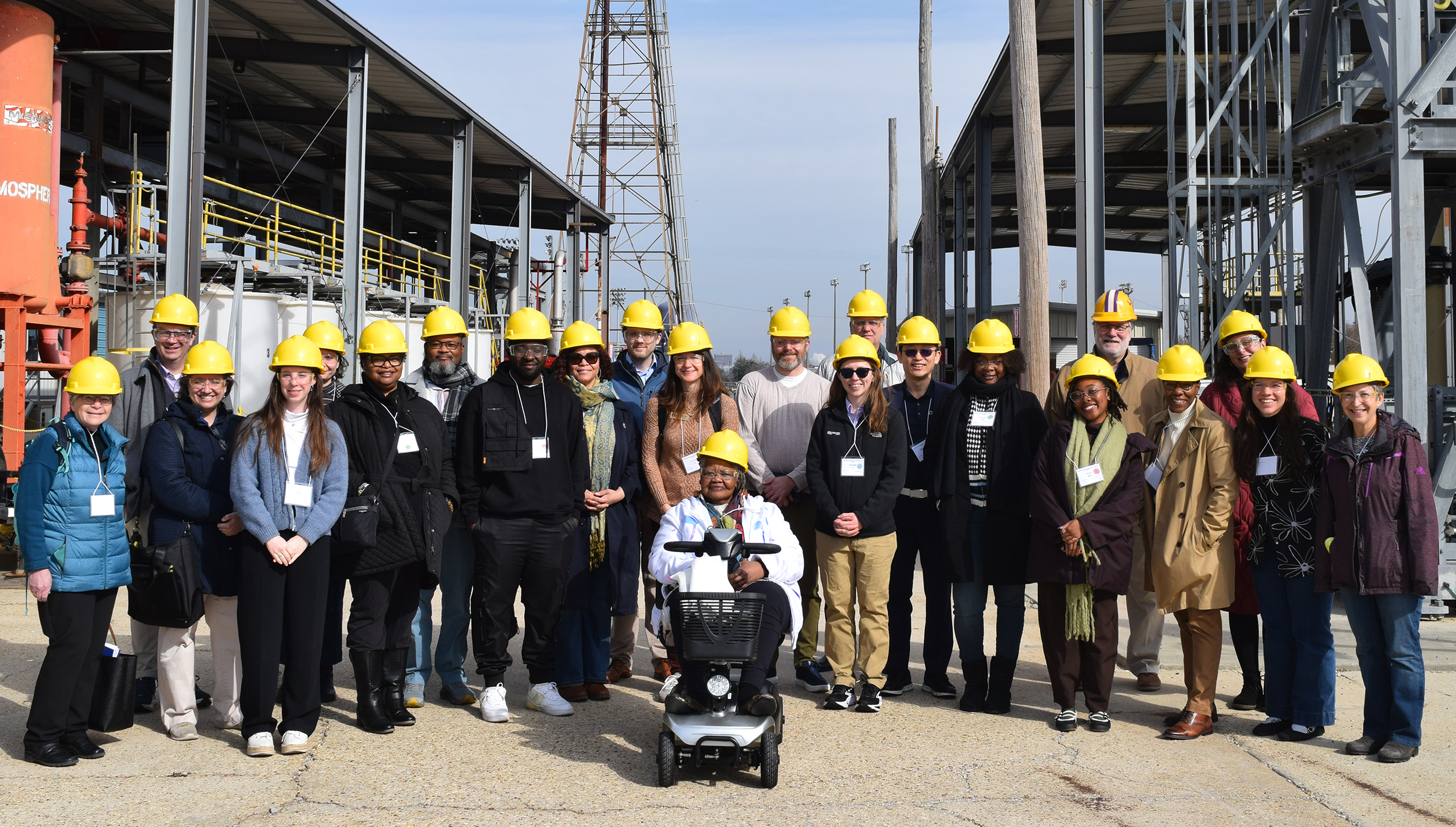
Community site visits bring participants directly into industrial and research facilities as well as neighborhoods affected by existing industrial development. Participants see schools, residential areas, power plants, natural amenities, research facilities, and community gathering spaces and hear from site managers and community leaders.
"Engaging with communities through experiential learning activities like site visits begins the process of rooting abstract technology into a place with all its history and memories of previous encounters with industrial plants. This enables conversations instead of silence or skepticism,” says Matthew Realff, professor and David I.J. Wang Faculty Fellow in the School of Chemical and Biomolecular Engineering, and faculty director for Interdisciplinary Sustainability Education at the Brook Byers Institute for Sustainable Systems.
The SCEFA effort is a culmination of SCoRE’s relationship and project-building work over the past 11 years. Community partners who participated in the SEDAC Hub and SCEFA discussions have become key contributors to a broader regional effort that now encompasses teams from Georgia, Alabama, Mississippi, and Louisiana. The initiative brings together leaders of nonprofits and community-based organizations, researchers, student interns, and project developers to learn from each other and develop education and outreach materials related to EETTs.
Over the course of one year, participants engaged in multiple online workshops, two in-person workshops — in Baton Rouge, Louisiana, hosted by Louisiana State University, and in Mobile, Alabama, hosted by the University of South Alabama — and developed education and outreach materials to be used by community-based organizations.
The program also encourages the formation of what SCoRE describes as "unlikely coalitions" among community organizations, universities, and industry professionals. The Georgia team, spearheaded by a researcher at Georgia College and State University, is exploring how nature-based sequestration and biomass energy may be used to enhance the land and other natural amenities that residents in their rural communities see as their legacy. The Alabama team focused on carbon capture, utilization, and storage (CCUS), which is the key EETT focus in their geography. The lead organization for that team, Iyai+ (Introducing Youth to American Infrastructure), developed a role-playing game that helps participants explore the opportunities and challenges associated with CCUS, identify key stakeholders, and practice asking critical questions about proposed projects.
Jennifer Hirsch, senior director of SCoRE, who is a cultural anthropologist and serves as project lead, explained, “SCEFA prioritizes building relationships over time, with a core focus on experiencing and learning together, rather than trying to get one side to see the other’s point of view. It is only when community perspectives are taken into account that truly innovative solutions will emerge that benefit both people and climate.”
The emphasis is on process rather than predetermined outcomes. Participants spend time learning how to ask better questions, evaluate evidence, and recognize uncertainties. By investing in a shared process, participants are often better able to navigate disagreement without becoming defensive.
The approach is already producing results. Technologists involved in the program have expressed greater interest in engaging with communities earlier in their research and development process. Researchers are exploring new ways to communicate findings more clearly and transparently. Community partners are gaining knowledge, tools, and resources that allow them to engage on their own terms when new projects are proposed.
“Lasting solutions emerge when researchers and communities work together from the beginning, asking the right questions and considering both the opportunities and tradeoffs,” said Tim Lieuwen, executive vice president for Research. “SCEFA offers a powerful model for developing energy solutions with communities, not simply for them. This collaborative approach reflects how Georgia Tech can help address complex challenges that no institution or community can solve alone.”