
Rapid Testing Offers Path to More Sustainable Material Choices
Choosing the right materials for manufacturing products involves balancing durability, cost, manufacturability, and environmental impact. Yet those decisions are not always guided by a clear understanding of how materials age and fail under real-world conditions, especially for recycled materials like plastics.
-Written by Seungho Lee
Recycled materials promise a cleaner future, but recycled content alone does not necessarily make a product sustainable. At Georgia Tech’s Daedalus Lab, assistant professor, National Science Foundation CAREER Award recipient, and Brook Byers Institute for Sustainable Systems Faculty Fellow Christos Athanasiou and postdoctoral researcher Danqi Sun are working to provide greater certainty to designers and engineers by rethinking how materials are tested for their fracture characteristics. Their article in Science Advances details a new testing protocol that reduces cost, increases speed, and simulates real-world conditions.
Materials shape nearly every part of modern life, from packaging and consumer products to bridges and medical devices. Choosing the right material involves balancing durability, cost, manufacturability, and environmental impact. Yet those decisions are not always guided by a clear understanding of how materials age and fail under real-world conditions, especially for recycled materials like plastics.
One way that materials frequently fail is by cracking. A small crack can begin almost invisibly. Over time, it can spread from regular wear and tear and exposure to common environmental factors like moisture, temperature fluctuations, or even dirt. Eventually, the crack expands, and the part fails. Engineers have studied fracture for more than a century, but connecting the science of cracking to practical decisions about sustainability remains a major challenge.
The characteristics of recycled plastics often vary from those of the same material in unrecycled, or virgin, form. Products made from recycled plastics may be sold with sustainability claims under the assumption that they will perform as if they were made with virgin material. However, premature failure requiring repair or replacement can quickly change the sustainability equation as well as the acceptance of recycled materials by manufacturers and consumers.
Beyond Conventional Fracture Testing
Materials rarely fail due to a single factor. They may be exposed to several factors simultaneously, such as mechanical loading, chemical environments, temperature changes, moisture, and time. Traditional fracture protocols test one specimen at a time under carefully controlled laboratory conditions, which bear little resemblance to the real world. To move beyond this limitation, Sun developed an in-situ, high-throughput platform capable of studying how materials degrade and fail under more realistic conditions.
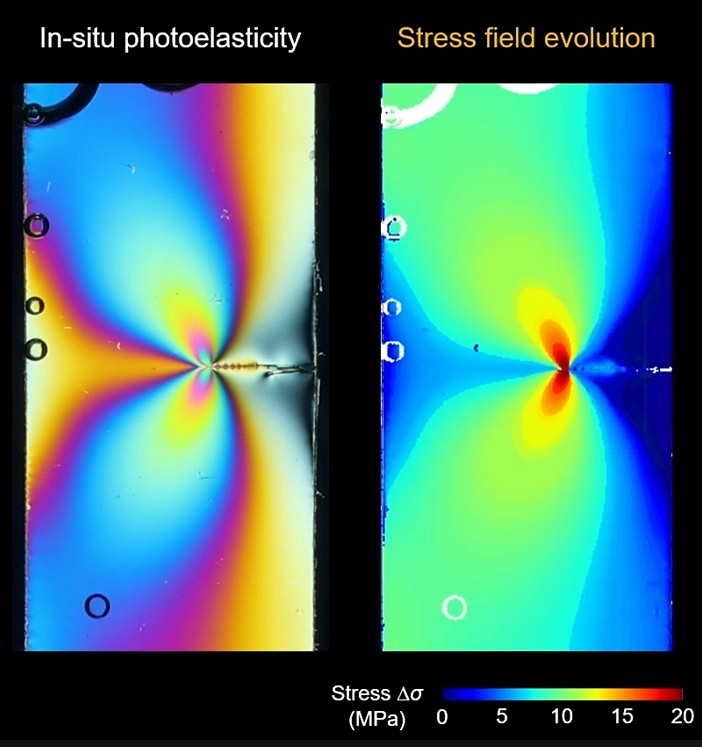
The platform changes conventional fracture testing in three important ways. First, it can test multiple specimens simultaneously rather than one at a time. By monitoring samples in parallel, testing time can be reduced by more than 60%. Second, it allows materials to be tested in realistic environments. In this study, researchers examined virgin and recycled plastics in alkaline environments that resemble conditions encountered in applications like landfill liner membranes and geotextiles. Third, the platform incorporates an imaging technique known as photoelasticity, which reveals the formation of stress fields that form around the origin of a newly developing crack. This allows researchers to see cracks develop earlier than before, giving them a clearer picture of the forces that drive crack growth.
The researchers have made the technology available for licensing through Georgia Tech’s Office of Technology Licensing. “Our goal was to make fracture testing not only faster but also more informative,” Sun said. “By combining high-throughput testing, realistic environments, and full-field stress imaging, we can better understand how materials fail under conditions closer to real-world applications.”
An Honest View of Sustainability
Recycled plastics are often viewed as a greener choice. But according to the study, it’s not always so straightforward. If a recycled product fails prematurely and needs to be replaced frequently, its environmental and economic costs can increase despite its recycled content. As Athanasiou puts it, “Failing materials don’t just break products. They can break sustainability promises.”
For example, comparing virgin polyethylene terephthalate (PET) with recycled PET (rPET) in applications such as landfill geotextiles, the researchers discovered that rPET showed lower resistance to environmental stressors, particularly in alkaline conditions over a pH of 9. In this application, specifying rPET over virgin PET would likely eliminate all of the presumed economic and environmental advantages of using a recycled material.
“Recycling is essential, but recycled content alone does not tell the full story. If a material fails too soon, the environmental benefits can disappear,” Athanasiou said.
From Cracks to Circularity
For the researchers, the significance of the work extends beyond recycled plastics. The broader goal is to provide a fast, affordable, and realistic platform for evaluating the sustainability of any material choice. Because current testing protocols are costly, not widely available, and limited in the information they yield, engineers, manufacturers, and policymakers often have little choice but to continue to specify non-recycled materials because they will perform as expected. Having cheap and accurate data on recycled materials will help to accelerate their adoption because matching the engineering properties of recycled materials to their most appropriate applications will become more obvious.
The researchers also hope to expand the platform to simulate even more complex environments and apply it to a wider range of materials. Because the system generates large amounts of detailed data, it may enable opportunities to use computational modeling or artificial intelligence to digitally simulate mechanical testing, driving down costs and expanding availability even more.
The larger vision is a future in which sustainability is judged not by labels or assumptions, but by evidence for how a material performs, how long it lasts, how it fails, and what it costs society and the environment over its full lifetime.
Please visit the Daedalus Lab YouTube channel to see an explainer video about this new testing protocol: https://youtube.com/watch?v=zmRhiRIiAkQ
Read the paper here: https://www.science.org/doi/10.1126/sciadv.aeh0456
This research was supported by the National Science Foundation CAREER Award No. 2338508.