
Scientist Maps Biodiversity on a Warming Southern Landscape
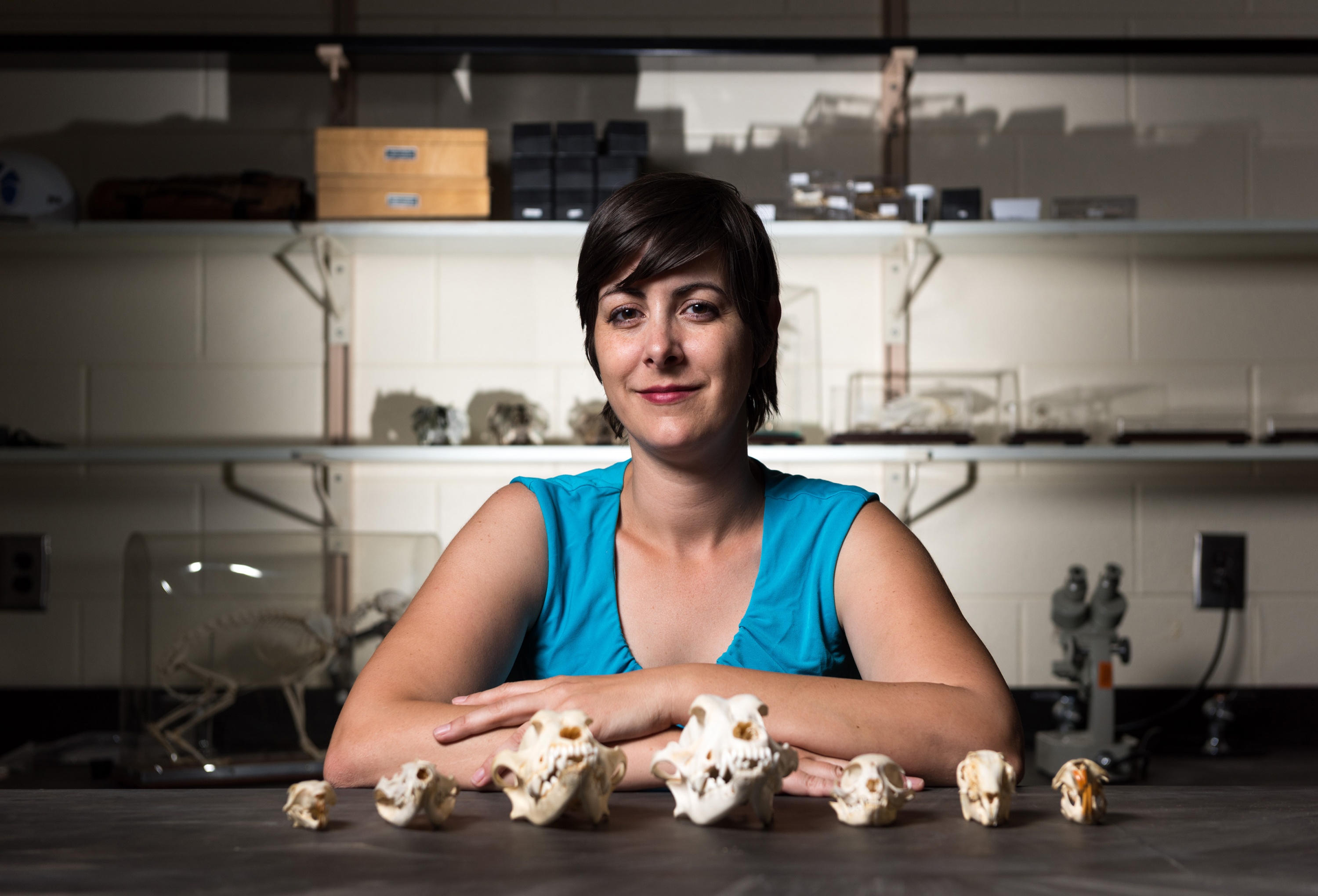
McGuire leads Georgia Tech’s Spatial Ecology and Paleontology Lab, whose motto is “learning from the past how to conserve the future.” She uses modern, historical, and paleontological specimens to identify how communities of plants and animals move across landscapes over long time scales in response to past climate shifts.
- by Anne Wainscott-Sargent
Jenny McGuire, an associate professor in the Schools of Biological Sciences and Earth and Atmospheric Sciences at Georgia Tech, is building a regional blueprint for safeguarding biodiversity in the southeastern United States while drawing insights from half a world away in Denmark. She is the Harry and Anna Teasley Professor in Ecology and Brook Byers Institute for Sustainable Systems (BBISS) faculty fellow. She is currently on faculty development leave in Copenhagen where she is sharpening her work with fresh perspectives from European conservation practice.
McGuire, winner of the National Science Foundation’s prestigious Faculty Early Career Development Award, describes herself as a spatial or landscape ecologist, rather than a traditional wildlife biologist. She currently leads Georgia Tech’s Spatial Ecology and Paleontology Lab, whose motto is “learning from the past how to conserve the future.” She uses modern, historical, and paleontological specimens to identify how communities of plants and animals move across landscapes over long time scales in response to past climate shifts. Her goal is to identify strategies to conserve as much biodiversity as possible in the face of an increasingly volatile climate.
Twice awarded with Sustainability Next Seed Grants by BBISS, most recently in 2025, McGuire is using that support to knit together scientists, conservation groups, agencies, and students to understand how plants and animals are moving in response to both climate and land-use change.
“I’ve been wanting to pivot to a more regional approach toward this work,” McGuire said. “The Southeast, and especially the Atlanta region, is really critical because we sit at this important geographic point where southern Appalachia and the Piedmont come together.”
As species track cooler temperatures and changing rainfall patterns, many are expected to move upslope into the southern Appalachians, even as Atlanta’s urban and suburban footprint continues to expand northward. “There’s a lot of competing stressors on the regional environment,” she said.
Building a Regional Conservation Community
One of McGuire’s Sustainability Next Seed Grants, in collaboration with Nicole Kennard, BBISS Assistant Director for Community Engaged Research, supports a partnership with Roots Down, an innovative urban land-use nonprofit working with the cities of Avondale Estates and Atlanta to understand how native plant restoration affects ecosystem health. Georgia Tech students established protocols to survey sites before and after restoration to track changes.
The other seed grant McGuire received enabled her to convene a conference that brought together nonprofit conservation organizations, government agencies such as Georgia’s Department of Natural Resources, and academics from across the Southeast. The group formalized their collaboration as the Wildlife Ecology in the Piedmont and Appalachia (WEPA) coalition. They agreed to survey the resources, such as data, projects, and people, that would support a regional wildlife conservation effort. Over the past semester, her team compiled those resources and shared results back with partners in a second virtual conference.
Early indications from this survey show a strong focus on mammals in urban Atlanta, including 11 camera-trap projects. Two of these projects follow transects from urban cores to suburbs to see how animals move across the city. This group has conducted extensive studies on how wildlife use roadside drainage structures, such as culverts, to move beneath roadways, and how animals are shifting to more nocturnal activity to avoid traffic.
Making connections among current and ongoing studies reveals knowledge gaps where both contemporary and historical data are sparse. Although historical records are held by regional museums, including the Georgia Museum of Natural History, many collections across the broader region remain undigitized. “Those historic distributions exist somewhere, but they’re really difficult to access,” McGuire said. Identifying these data sets is “critical to establish a baseline of where things lived in the past so we can understand how human landscapes and climate change are affecting things today and into the future.”
She’s also working with Georgia Tech for Georgia’s Tomorrow (GT²), a new College of Sciences initiative focused on regional impact. The program is hiring a postdoctoral fellow whom McGuire will supervise to jumpstart a collaborative research agenda around biodiversity dynamics.
McGuire’s work is increasingly collaborative, drawing on expertise across Georgia Tech and partner institutions like Atlanta’s Fernbank Museum.
Benjamin Freeman, assistant professor in the School of Biological Sciences, focuses on bird ecology to detect shifts in diversity and species ranges. In a new North Georgia Bird Project, with the Georgia Department of Natural Resources, he is resurveying bird communities across 13 mountain ridges, concentrating on about 40 forest bird species. His research tests projections that a rapidly warming climate could leave Georgia with very different plant and animal communities within a few human generations. “There’s no substitute for going out there and seeing what is actually changing,” says Freeman.
In a May 2026 Nature Reviews Biodiversity paper co-authored with McGuire, he combines his field-based bird surveys with her paleo-ecological analysis of fossil and pollen records.
“We make models that predict how species and biological communities will respond to warming, then we go into nature to test those predictions, and finally refine our models when reality doesn’t match what we expected,” he says.
Another Georgia Tech faculty member, Steve Mussman, assistant professor in the College of Computing, brings a different skill set to the project. “I’m a computer and data scientist. I can help with the technical modeling aspects to make the analyses valid and useful,” he says.
One of the ways he does this is to identify “sampling bias” in camera-trap and citizen science data, which may not be uniformly sampled from the animal population. “I’m really excited to bring machine learning and statistics to a very practical problem,” he adds.
Together, these collaborations support WEPA’s overarching goal: to integrate past and present data into tools that help decision-makers prioritize conservation actions under climate uncertainty.
Lessons From Denmark
For the past nine months, McGuire has been on faculty development leave in Copenhagen, using the time to think deeply about habitat connectivity and how species move across altered landscapes. There, she found a natural comparison point.
“The entire country of Denmark is about the same geographic size as the region we’re interested in,” she noted. “And population-wise, it’s smaller than the Atlanta metro area.”
What struck her most was how thoroughly human activity has reshaped Denmark. “There’s no part of the entire country that hasn’t been very heavily modified by humans,” she said. “At this point, all conservation is gardening.”
By contrast, she sees the Southeast as having retained a foundation of the historical ecology. Forests in the Appalachians have been heavily affected, “but not nearly for as long, or to the same extent, as in Europe,” she said. “It’s kind of nice to think about how we still have a slightly more natural landscape to start with that we can then maintain moving forward.”
In Denmark, McGuire has been learning from conservation biologists who are developing tiered metrics to assess restoration success, from basic, low-cost measures such as tree diameter and understory volume to more advanced tools like genomic analyses. She hopes to adapt similar frameworks to help southeastern land managers and communities assess ecosystem health under tight budgets.
From Appalachia to Berkeley to Georgia Tech
McGuire grew up in southern Virginia, where her love for biodiversity and the southern Appalachians first took root. She went on to earn her Ph.D. in integrative biology from the University of California, Berkeley, where she deepened her focus on how species and ecosystems respond to environmental change over long time scales.
She then completed postdoctoral research at the National Evolutionary Synthesis Center and at the University of Washington, where she expanded her quantitative and interdisciplinary toolkit — experience that now underpins her work at Georgia Tech, bridging ecology, paleontology, data science, and conservation planning.
“From my perspective, there’s an ethical imperative to maintain the world around us,” she said. “Being in nature and recognizing that we’re being good neighbors and good partners to the other species on the planet is just incredibly rewarding. We must leave the next generation a planet that is at least as healthy as the one we inherited."
Life Beyond the Lab
Beyond research and mentoring, McGuire enjoys hiking and biking. Much of her free time during her Copenhagen sabbatical has revolved around her young daughter, who turns 4 this summer.
McGuire looks forward to the occasion, which follows a cherished Danish school tradition: The child circles a picture of the sun once for each year of their life, holding a small Earth, while a parent holds up photos and tells a story from each year.
Returning Home
As she prepares to return to Georgia Tech in August after a year away, McGuire will resume her fieldwork and continue her conservation initiatives throughout the Southeast. She hopes to draw in collaborators from all across Georgia Tech to help build a truly regional, interdisciplinary effort around biodiversity and climate resilience.
“Within WEPA, we’re really excited to bring more people into this work. For anyone interested in conservation modeling, sensors and AI, policy, or how nature supports communities,” she said, “there’s a place in this regional effort to understand and protect biodiversity.”